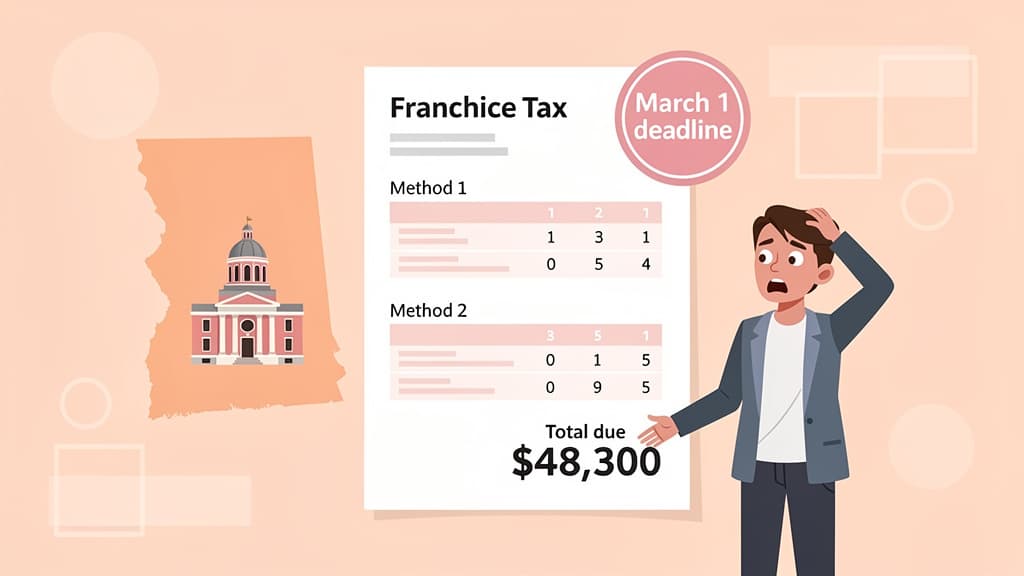
The minimum Delaware corporation franchise tax is $175 (Authorized Shares Method) or $400 (Assumed Par Value Capital Method), plus a $50 annual report fee, due March 1 each year. Delaware LLCs pay a flat $300 annual tax due June 1, with no annual report. Both 2026 deadlines have passed: if you haven't paid, Delaware has already added a $200 late penalty plus 1.5% interest per month, and paying now stops the interest from compounding.
Key takeaways:
- Corporation franchise tax: minimum $175 (Authorized Shares Method) or $400 (Assumed Par Value Capital Method), maximum $200,000, plus the $50 annual report fee, due March 1
- LLC, LP, and GP annual tax: flat $300, due June 1, no annual report required
- Late payment costs a $200 penalty plus 1.5% monthly interest; prolonged non-payment makes the entity void
- Corporations owing over $5,000 pay estimated installments; the next ones are September 1 and December 1, 2026
- Delaware's default bill uses the Authorized Shares Method; recalculating with the Assumed Par Value Capital Method typically cuts a startup's bill from tens of thousands of dollars to $400–$2,000
| Deadline | What's Due | Who It Applies To |
|---|
| March 1 | Corporation franchise tax + annual report | All Delaware domestic corporations |
| June 1 | LLC/LP/GP annual tax ($300 flat) | All Delaware LLCs, LPs, and GPs |
| June 1 | Q1 estimated franchise tax (40%) | Corporations with franchise tax > $5,000 |
| September 1 | Q2 estimated franchise tax (20%) | Corporations with franchise tax > $5,000 |
| December 1 | Q3 estimated franchise tax (20%) | Corporations with franchise tax > $5,000 |
| March 1 | Q4 estimated franchise tax (20%) | Corporations with franchise tax > $5,000 |
Legal basis: Delaware Code Title 8 §502, §503, Title 6 §18-1107

Every domestic corporation incorporated in Delaware must pay an annual franchise tax and file an annual report by March 1. This deadline does not shift for weekends or federal holidays: Delaware does not follow the federal rule that pushes deadlines to the next business day. March 1, 2026 fell on a Sunday and the deadline stayed March 1 (the online filing portal accepts filings around the clock, including weekends).
This is a state-level tax based on your corporate structure, not on income. It applies whether your company earned $10 million in revenue or $0. The franchise tax is the cost of maintaining your Delaware corporate charter.
The annual report filing fee is a separate $50 charge on top of the franchise tax itself.
Many founders confuse the Delaware franchise tax with income tax. They are completely separate obligations:
- Federal income tax (Form 1120 or 1120-S): Based on your company's profits, due April 15.
- Delaware franchise tax: Based on your authorized shares or capital structure, due March 1. Owed regardless of profitability.
- Delaware state income tax: If your corporation earns income in Delaware, you may also owe Delaware corporate income tax (8.7% flat rate), filed on Form 1100. This is separate from the franchise tax.
For the full federal deadline calendar, see our complete 2026 business tax deadline guide.
Delaware provides two methods for calculating corporation franchise tax. Your annual report bill will show the amount using the Authorized Shares Method by default. For most startups, this default amount is dramatically higher than what you actually owe.
You have the right to use whichever method produces the lower tax amount.
This is the method Delaware uses on the initial bill you receive. The formula:
- 5,000 or fewer authorized shares: $175 (the minimum tax)
- 5,001 to 10,000 authorized shares: $250
- Each additional 10,000 shares (or fraction thereof) above 10,000: add $85
Minimum tax: $175
Maximum tax: $200,000 ($250,000 for designated Large Corporate Filers)
These are the rates published on the Delaware Division of Corporations franchise tax calculation page.
The problem is obvious for startups. Most venture-backed Delaware corporations authorize 10 million shares (or more) when they incorporate. This is standard practice because it gives flexibility for future funding rounds, option pools, and stock splits. But under the Authorized Shares Method, 10 million authorized shares produces a massive tax bill.
Example: 10 Million Authorized Shares (Authorized Shares Method)
- First 10,000 shares: $250
- Remaining 9,990,000 shares: 9,990,000 ÷ 10,000 = 999 increments × $85 = $84,915
- Total: $85,165
For a startup that might have $500,000 in assets and hasn't generated a profit yet, an $85,165 franchise tax bill is absurd. That's where the second method comes in.
This method considers three factors:
- Total gross assets (from your federal tax return, Form 1120, Schedule L)
- Total issued shares (all classes of stock actually issued, not just authorized)
- Total authorized shares (all classes)
The formula:
- Calculate assumed par value per share: Total Gross Assets ÷ Total Issued Shares
- Calculate assumed par value capital: Assumed Par Value Per Share × Total Authorized Shares
- Calculate franchise tax: $400 for each $1,000,000 (or portion thereof) of assumed par value capital
Minimum tax: $400
Maximum tax: $200,000
If total gross assets are $0, the minimum tax of $400 applies.
Example: Same Startup Using Assumed Par Value Capital Method
Company details:
- Authorized shares: 10,000,000
- Issued shares: 1,000,000
- Total gross assets (from federal tax return): $500,000
Step 1: Assumed par value per share = $500,000 ÷ 1,000,000 = $0.50
Step 2: Assumed par value capital = $0.50 × 10,000,000 = $5,000,000
Step 3: Franchise tax = ($5,000,000 ÷ $1,000,000) × $400 = $2,000
The Comparison
| Method | Tax Amount |
|---|
| Authorized Shares Method | $85,165 |
| Assumed Par Value Capital Method | $2,000 |
| Savings | $83,165 |
This is not a hypothetical. This is a real scenario that applies to thousands of startups every year. The Assumed Par Value Capital Method requires you to report total gross assets from your federal tax return, but the savings are enormous.
When you file your annual report on the Delaware Division of Corporations website, you can enter your total gross assets and total issued shares. The system will calculate the tax using both methods and apply the lower amount.
If you file by mail, you must explicitly calculate and report using the Assumed Par Value Capital Method. Otherwise, the Authorized Shares Method is applied by default.
Key requirement: You must have filed (or be filing) a federal tax return to use this method, because total gross assets come from Schedule L of Form 1120.
Every Delaware domestic corporation must file an annual report alongside the franchise tax payment. The filing is done through the Delaware Division of Corporations website.
Annual report fee: $50 (separate from the franchise tax)
The annual report requires basic information:
- Corporation name and Delaware file number
- Registered agent name and address
- Principal office address
- Names and addresses of officers and directors
The annual report and franchise tax are filed together. You cannot file the annual report without paying the franchise tax.
Delaware LLCs, limited partnerships (LPs), and general partnerships (GPs) do not pay franchise tax the same way corporations do. Instead, they pay a flat annual tax of $300, due June 1 each year.
Key differences from the corporation franchise tax:
- No annual report required for LLCs (Delaware does not require an annual report from LLCs)
- Flat fee: the $300 is the same regardless of revenue, assets, or number of members
- Different deadline: June 1 instead of March 1
- No calculation methods to choose between: it's just $300
For founders choosing between an LLC and a corporation structure, see our S-Corp vs LLC guide for a full comparison of tax implications.
Corporations with a franchise tax liability exceeding $5,000 must make estimated quarterly payments. The schedule:
| Payment | Percentage Due | Deadline |
|---|
| Q1 | 40% of estimated annual tax | June 1 |
| Q2 | 20% of estimated annual tax | September 1 |
| Q3 | 20% of estimated annual tax | December 1 |
| Q4 | 20% of estimated annual tax (remainder due with annual report) | March 1 |
The first payment is larger (40%) because estimated payments begin after the annual report deadline has passed. Any balance remaining is due with the March 1 annual report and franchise tax filing.
If your corporation's franchise tax is $5,000 or less, you pay the full amount once per year by March 1.
Delaware imposes significant penalties for missing franchise tax deadlines, and the consequences escalate quickly.
| Penalty Type | Amount |
|---|
| Late filing penalty | $200 |
| Interest on unpaid tax | 1.5% per month |
| Annual report late fee | Included in $200 penalty |
Interest begins accruing on March 2 and compounds monthly. A corporation that files six months late on a $2,000 franchise tax bill would owe:
- $2,000 (franchise tax) + $50 (annual report) + $200 (penalty) + $180 (interest at 1.5% × 6 months on $2,000) = $2,430
| Penalty Type | Amount |
|---|
| Late payment penalty | $200 |
| Interest on unpaid tax | 1.5% per month |
An LLC that misses the June 1 deadline owes $300 (annual tax) + $200 (penalty) + interest.
Both 2026 deadlines have passed, and interest of 1.5% per month keeps accruing until you pay. Corporations file the overdue annual report and pay online at the Delaware Division of Corporations portal; LLCs pay the $300 annual tax plus penalty and interest through the same portal. No paper forms are required.
Worked example (LLC paying July 15, 2026): $300 annual tax + $200 late penalty + about $9 interest (1.5% × 2 months on the $300 tax) = roughly $509.
For balance questions, call the Division's Franchise Tax section at (302) 739-3073, option 3, or email [email protected]. You can confirm your entity's status on the Delaware entity search.
If a Delaware corporation or LLC fails to pay franchise taxes for an extended period, the entity's status in Delaware becomes "void." This means:
- The entity loses its good standing in Delaware
- It cannot conduct business, file lawsuits, or defend lawsuits in Delaware
- Banks and partners may refuse to work with a void entity
- Investors will flag this in due diligence
Reviving a void entity requires paying all back taxes, penalties, and interest, plus a revival fee (at least $400 for corporations). The longer you wait, the more expensive it gets. For corporations with high authorized-share-based franchise taxes that never switched to the Assumed Par Value Capital Method, years of back taxes can accumulate to tens of thousands of dollars.
Delaware is not the only state that charges a franchise tax or annual fee. Here's how it compares:
| State | Annual Fee/Tax | Filing Requirement |
|---|
| Delaware (Corporation) | $175–$200,000 (varies by method) + $50 annual report | March 1 |
| Delaware (LLC) | $300 flat | June 1 |
| California | $800 minimum franchise tax (all entities) | April 15 (with tax return) |
| New York | $25 biennial filing fee (LLC), filing fee based on gross income | Varies |
| Texas | No franchise tax if revenue under $2.47M | May 15 |
| Nevada | $500 annual business license fee + $150 annual list filing | Annual, varies |
| Wyoming | $60 annual report (or based on assets for LLCs) | Anniversary month |
California's $800 minimum franchise tax applies to all LLCs and corporations, regardless of income, similar to Delaware's flat LLC fee but higher. States like Wyoming and Texas have lower ongoing costs, which is why some founders choose them over Delaware when VC preference isn't a factor.
Delaware is home to more than 2.1 million registered legal entities, including 66.7% of Fortune 500 companies, according to the Delaware Division of Corporations' 2024 annual report. Despite the franchise tax, it remains the dominant choice for startup incorporation. Here's why:
Court of Chancery. Delaware's dedicated business court has judges (chancellors), not juries, who specialize in corporate law. Disputes are resolved faster and more predictably than in general-purpose courts.
Established case law. Over a century of corporate legal precedent means fewer surprises. Attorneys, investors, and boards know exactly how Delaware law will be interpreted in most situations.
Investor expectation. Most venture capital firms expect portfolio companies to be Delaware C-Corps. Fund legal documents are often drafted with Delaware law in mind. Incorporating elsewhere can create friction during fundraising.
Flexibility in corporate governance. Delaware's General Corporation Law (DGCL) allows significant flexibility in how boards operate, how stock classes are structured, and how shareholder rights are defined.
Privacy. Delaware does not require the names of shareholders or members to be listed in public filings. Officers and directors are listed in the annual report, but ownership remains private.
For most startups raising venture capital, the benefits of Delaware incorporation outweigh the annual franchise tax cost — especially once you know to use the Assumed Par Value Capital Method.
This is the single most expensive mistake founders make with Delaware franchise tax. The default bill uses the Authorized Shares Method, and many founders simply pay it without realizing they can use the Assumed Par Value Capital Method instead. As shown in the example above, the difference can be $83,000+ for a typical startup. Always calculate using both methods and pay the lower amount.
The Delaware franchise tax deadline is March 1, six weeks before the federal income tax deadline of April 15. Founders who are focused on their federal return often miss the Delaware deadline entirely. And unlike federal deadlines, Delaware does not move the deadline when March 1 falls on a weekend (as it did in 2026).
Some founders forget about Delaware franchise taxes entirely, especially if their company operates in another state. After missing payments for a year or more, the entity becomes void. Reviving a void entity costs a minimum of $400 in revival fees on top of all back taxes, penalties, and interest. For a startup trying to raise its next round, a void Delaware entity is a red flag that can delay or kill a deal.
If you have both a Delaware LLC and a Delaware corporation (common in holding company structures), each entity has its own annual obligation. The LLC owes $300 by June 1. The corporation owes franchise tax plus the $50 annual report by March 1. These are separate filings with separate deadlines.
Delaware obligations live outside your federal tax workflow, which is exactly why founders miss them. Jupid tracks the March 1 corporation deadline and the June 1 LLC deadline in your tax deadline calendar and reminds you before they hit. Because Jupid connects to your bank and categorizes transactions with 95.9% accuracy, the total gross assets figure that the Assumed Par Value Capital Method requires is current when you file, not reconstructed in a late-February panic. Ask the AI accountant in WhatsApp or iMessage "What do I owe Delaware?" and get an answer based on your actual books. Try Jupid.
| Item | Amount |
|---|
| Corporation minimum franchise tax | $175 |
| Corporation maximum franchise tax | $200,000 |
| Annual report fee (corporations) | $50 |
| LLC/LP/GP annual tax | $300 flat |
| Late filing/payment penalty | $200 |
| Interest on unpaid tax | 1.5% per month |
| Corporation franchise tax deadline | March 1 |
| LLC annual tax deadline | June 1 |
| Revival fee (minimum) | $400 |
Delaware franchise tax catches more founders off guard than almost any other state-level obligation. The March 1 deadline is earlier than most expect, the default calculation method produces bills that look like accounting errors, and the penalties for ignoring it (including having your entity go void) are real and expensive.
The fix is straightforward: know the deadlines, use the Assumed Par Value Capital Method if you're a corporation with more than a few thousand authorized shares, and pay on time. For LLCs, it's even simpler — $300 by June 1, no report required.
Set your reminders now. A few minutes of attention to Delaware's annual requirements can save you thousands of dollars and keep your entity in good standing for investors, partners, and banks.
Disclaimer
This article provides general information about Delaware franchise tax requirements and should not be considered tax or legal advice. Delaware tax laws and rates may change, and specific circumstances may affect your obligations. The calculation examples are illustrative and based on the methods published by the Delaware Division of Corporations. Always verify current rates and deadlines on the Delaware Division of Corporations website and consult with a qualified tax professional or attorney for advice specific to your situation.
Last Updated: July 7, 2026