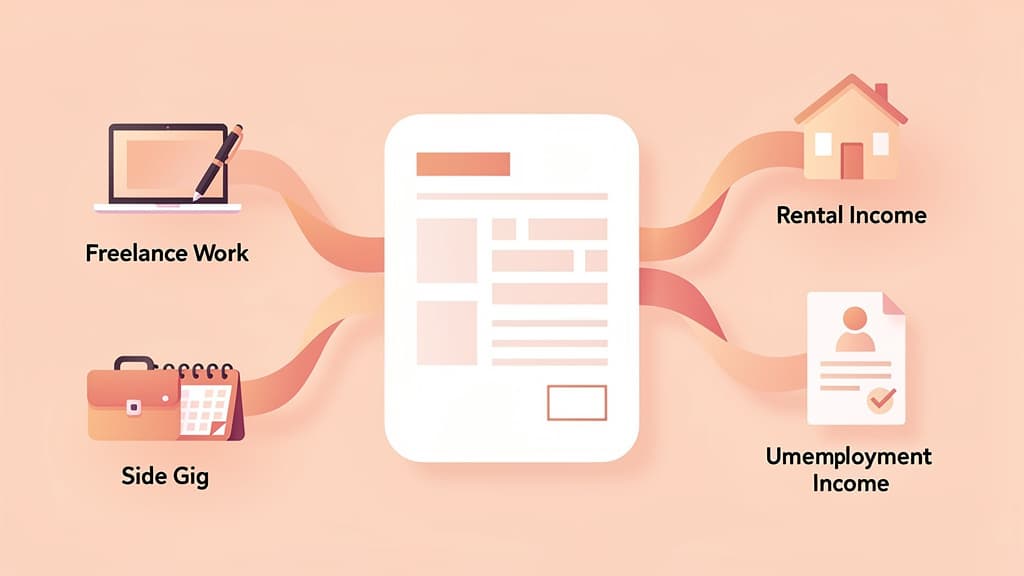
Form 1040 is the U.S. Individual Income Tax Return, the two-page form every US taxpayer files to report annual income and compute federal tax. For tax year 2025 (the return due April 15, 2026), the standard deduction is $15,750 single, $31,500 married filing jointly, and $23,625 head of household. The 2025 revision also renumbered the form: AGI now sits on Lines 11a/11b, the deduction on Line 12e, QBI on Line 13a, total tax on Line 24, and a new Line 13b carries the OBBBA deductions (tips, overtime, car loan interest, seniors) from Schedule 1-A.
Key takeaways:
2025 standard deduction: $15,750 single/MFS, $31,500 MFJ, $23,625 HoH (raised by OBBBA); 2026: $16,100 / $32,200 / $24,150 (Rev. Proc. 2025-32)
Child Tax Credit is now $2,200 per child (OBBBA, 2025 onward); up to $1,700 refundable on Line 28
The 2025 form renumbered the back half: Line 22 = tax after credits, Line 23 = other taxes (SE tax), Line 24 = total tax, Line 33 = total payments
Line 30 is new: the refundable adoption credit (Form 8839, up to $5,000 refundable); Line 31 pulls from Schedule 3, Line 15
Filing deadline: April 15, 2026; Form 4868 extends filing (not payment) to October 15, 2026
Form 1040 itself is short. The complexity is in the schedules: Schedule 1 for additional income and adjustments, Schedule 2 for additional taxes, Schedule 3 for credits, Schedule A if you itemize, Schedule C if you run a business, Schedule SE for self-employment tax. The 1040 is the cover sheet that pulls all of those together into one number: refund or balance due. This guide walks every line of the 2025 revision, page 1 and page 2.
Form 1040, officially "U.S. Individual Income Tax Return," is the form every US tax resident uses to report their annual income and compute their federal income tax. It is the foundation of the individual tax system: every other schedule, worksheet, and supporting form ultimately ties back to a line on Form 1040.
Legal Basis: IRC §6011 requires every taxpayer to file a return; IRC §6012 specifies who must file; the form itself is prescribed by Treasury under IRC §6001.
You file Form 1040 if you are a US citizen, resident alien, or anyone with a US tax filing obligation whose income exceeds the filing threshold for your status.
You file Form 1040 if you are:
A US citizen or resident alien with gross income above the filing threshold
A self-employed person with $400+ in net earnings (regardless of total income)
A taxpayer claiming a refund of withheld taxes
A taxpayer claiming a refundable credit (EITC, additional CTC, premium tax credit)
Optional version for taxpayers age 65+. Same lines, larger print, standard-deduction chart printed on the form
Form 1040-NR
Nonresident aliens with US-source income
Form 1040-X
Amended return, used to correct a previously filed 1040
Form 1040-ES
Estimated tax voucher: quarterly payments for self-employed and others without W-2 withholding
This guide covers the standard Form 1040. If you're a nonresident alien, see Form 1040-NR. If you're amending, see Form 1040-X. If you're paying quarterly estimates, see our Form 1040-ES guide.
The 2025 figures below reflect the One Big Beautiful Bill Act (OBBBA, signed July 4, 2025), which raised the standard deduction and Child Tax Credit mid-year. The 2026 figures are from Rev. Proc. 2025-32, published October 2025.
Item
Tax Year 2025
Tax Year 2026
Standard deduction — Single / MFS
$15,750
$16,100
Standard deduction — Married Filing Jointly / QSS
$31,500
$32,200
Standard deduction — Head of Household
$23,625
$24,150
Additional std. deduction (65+ or blind, married)
$1,600 each
$1,650 each
Additional std. deduction (65+ or blind, single/HoH)
$2,000 each
$2,050 each
Senior deduction (65+, OBBBA, 2025–2028)
$6,000 per person
$6,000 per person
Child Tax Credit (max per child under 17)
$2,200
$2,200
CTC refundable portion (ACTC)
$1,700
$1,700
Credit for Other Dependents
$500
$500
Maximum EITC (3+ children)
$8,046
$8,231
Filing deadline
April 15, 2026 (Wednesday)
April 15, 2027
Extension deadline (Form 4868)
October 15, 2026
October 15, 2027
2025 marginal brackets (single filer): 10% to $11,925 → 12% to $48,475 → 22% to $103,350 → 24% to $197,300 → 32% to $250,525 → 35% to $626,350 → 37% above. 2026 marginal brackets (single filer): 10% to $12,400 → 12% to $50,400 → 22% to $105,700 → 24% to $201,775 → 32% to $256,225 → 35% to $640,600 → 37% above. MFJ thresholds are roughly double through the 32% bracket. See where you land with our tax bracket calculator.
Legal Basis: IRC §1 (tax brackets), IRC §63 (standard deduction), IRC §24 (Child Tax Credit), IRC §151 (dependents). 2025 figures from Rev. Proc. 2024-40 as amended by OBBBA; 2026 figures from Rev. Proc. 2025-32.
Check exactly one filing status box. Your filing status controls your standard deduction, tax brackets, and eligibility for many credits. The five options:
Single: Unmarried, divorced, or legally separated on December 31.
Married Filing Jointly (MFJ): Married on December 31, both spouses on one return (even if only one had income). Wider brackets and largest standard deduction; usually the best option for married couples.
Married Filing Separately (MFS): Married, but each spouse files separately. The form requires you to enter your spouse's SSN in the header and their full name in the filing status section. Rarely saves tax; chosen for non-tax reasons (liability separation, student loan math).
Head of Household (HoH): Unmarried + paid more than half the cost of keeping up a home + a qualifying person lived with you more than half the year. Larger standard deduction than Single. The IRS audits incorrect HoH claims often.
Qualifying Surviving Spouse (QSS): Available for the two years after a spouse's death if you have a dependent child. Uses MFJ brackets.
Two extra instructions printed on the form trip people up:
If you check HoH or QSS and the qualifying person is a child who is not your dependent, enter that child's name in the space provided under the checkboxes.
Nonresident alien spouse election: if you treat a nonresident or dual-status alien spouse as a US resident for the whole year, check the box below the status boxes and enter their name.
The 2025 header also carries checkboxes for special filings: "Filed pursuant to section 301.9100-2" (amended-election returns), "Combat zone," deceased-taxpayer date fields, and a new checkbox confirming your main home (and your spouse's, if filing jointly) was in the US for more than half of 2025 (that one matters for the Earned Income Credit).
Legal Basis: IRC §1(a)-(d) (rate schedules by status), IRC §2 (definition of HoH and surviving spouse). For a deeper walkthrough of HoH and the "qualifying person" rules, see IRS Publication 501.
The top of page 1 collects your name and SSN (they must match your Social Security card exactly; wrong middle initials get returns rejected), spouse's name and SSN if married, home address, and the Presidential Election Campaign checkbox ($3 designation, no tax impact).
The digital assets question must be answered by everyone: "At any time during 2025, did you: (a) receive (as a reward, award, or payment for property or services); or (b) sell, exchange, or otherwise dispose of a digital asset (or a financial interest in a digital asset)?" Answer Yes if you sold, swapped, spent, or were paid in crypto or NFTs; answer No if you only bought or held.
Each dependent gets a row: name, SSN, relationship, plus three checkbox columns on the 2025 form: (5) whether the dependent lived with you more than half of 2025 and was in the US, (6) full-time student or permanently and totally disabled status, and (7) whether they qualify you for the Child Tax Credit or the Credit for Other Dependents. More than four dependents: check the box and attach a statement.
Line 8 is the catch-all for income that doesn't fit Lines 1–7: self-employment income (Schedule C net profit), rental/royalty/K-1 income (Schedule E), unemployment, gambling winnings, alimony received (pre-2019 divorces), cancellation of debt, jury duty. The Schedule 1 Line 10 total flows here. See our Schedule 1 guide for the full breakdown.
Schedule 1 Part II "above-the-line" deductions reduce AGI directly, even if you take the standard deduction: half of SE tax, self-employed health insurance, SEP-IRA / Solo 401(k) / SIMPLE IRA contributions, student loan interest (up to $2,500), HSA contributions, educator expenses. Schedule 1 Line 26 flows here.
Line 9 minus Line 10. AGI is the most important number on the return: it's the base for Medicare premium calculations, financial aid (FAFSA), state tax in many states, and dozens of phaseout thresholds. On the 2025 form, AGI closes page 1 on Line 11a and reappears at the top of page 2 as Line 11b.
Page 2 is where AGI becomes a refund check or a balance due. The 2025 revision renumbered several lines here; the numbers below match the current form.
Lines 12a–12d are checkboxes that affect your standard deduction: someone can claim you (or your spouse) as a dependent, your spouse itemizes on a separate return, dual-status alien, and the age/blindness boxes (born before January 2, 1961, or blind, for you and your spouse). Each checked age/blindness box adds $1,600 (married) or $2,000 (single/HoH) to the 2025 standard deduction.
Line 12e is the deduction itself: the larger of your standard deduction or your itemized deductions from Schedule A Line 17. Roughly 90% of filers take the standard, but the OBBBA's $40,000 SALT cap makes itemizing worth re-checking for homeowners in high-tax states. Run both numbers in our standard vs itemized calculator.
20% deduction on qualified business income from self-employment, partnerships, S-corps, or qualifying rentals under IRC §199A, computed on Form 8995 (simplified) or Form 8995-A (full). The simplified form applies below taxable income of $197,300 single / $394,600 MFJ for 2025 ($201,750 / $403,500 for 2026). OBBBA made the deduction permanent and added a $400 minimum deduction (2026 onward) for anyone with at least $1,000 of active QBI. This is the most under-claimed deduction for solopreneurs; don't skip it.
Compute tax on Line 15 using the Tax Tables (income under $100K), the Tax Computation Worksheet ($100K+), the Qualified Dividends and Capital Gain Tax Worksheet (if you had qualified dividends or long-term gains: preferential rates), or the Schedule D Tax Worksheet (collectibles or depreciation recapture). Filing software picks the right one automatically.
For each qualifying child under 17 at year-end with a valid SSN: up to $2,200 (raised from $2,000 by OBBBA starting in 2025). For other dependents (children 17+, supported parents): $500 Credit for Other Dependents. Phaseout starts at $200,000 AGI single / $400,000 MFJ. Computed on Schedule 8812; the non-refundable portion lands here, the refundable portion (up to $1,700 per child) on Line 28.
Schedule 3 Part I captures non-refundable credits: foreign tax credit, child and dependent care (Form 2441), education credits (Form 8863), Saver's Credit (Form 8880), residential energy credits (Form 5695), general business credit (Form 3800).
Self-employment tax (from Schedule SE), Additional Medicare Tax (Form 8959), Net Investment Income Tax (Form 8960), unreported Social Security/Medicare on tips, household employment taxes (Schedule H), early IRA withdrawal penalty (Form 5329). For self-employed people, Line 23 is usually the biggest number on page 2.
Sum of all quarterly Form 1040-ES payments you made for the 2025 tax year plus any 2024 refund you applied to 2025. (New on the 2025 form: a space to enter a former spouse's SSN if you made joint estimated payments before divorcing.) If you're self-employed and didn't pay estimates, Line 26 is $0 and you may owe an underpayment penalty on Line 38.
Refundable credit for low-to-moderate income workers, computed from the EIC tables based on filing status, earned income, AGI, and qualifying children. Maximum 2025 EITC: $8,046 with 3+ children ($8,231 for 2026). Line 27b flags clergy filing Schedule SE; Line 27c is a checkbox to decline the EIC.
OBBBA made up to $5,000 of the adoption credit refundable starting in 2025. The refundable portion comes from Form 8839, line 13, and lands on Line 30, a line that sat "reserved for future use" on 2022–2024 forms.
Line 31 pulls the total of Schedule 3 Part II "Other Payments and Refundable Credits": net premium tax credit (Form 8962), amount paid with your extension request (Form 4868), excess Social Security/RRTA withheld (multiple employers exceeded the wage base), and the credit for federal tax on fuels (Form 4136).
If Line 33 is more than Line 24, you overpaid: Line 34 = Line 33 − Line 24. Line 35a is the amount you want refunded (35b/c/d are routing number, account type, account number for direct deposit; check the box if Form 8888 splits the deposit). Line 36 is any amount applied to your 2026 estimated tax instead.
If Line 24 exceeds Line 33, Line 37 = Line 24 − Line 33. Pay by April 15 to avoid late-payment penalty and interest, even if you extend the filing deadline.
If you underpaid estimates during the year, the penalty is calculated on Form 2210. Leave Line 38 blank and the IRS calculates it for you; complete Form 2210 yourself only to claim the annualized income exception.
The rule: add up your Schedule A line items — medical above 7.5% of AGI, SALT capped at $40,000 for 2025 ($40,400 for 2026), mortgage interest on up to $750K of debt, charitable contributions, disaster casualty losses. If the total exceeds your standard deduction, itemize. Most filers still don't itemize, but the OBBBA's quadrupled SALT cap changed the math for homeowners in high-tax states (NY/CA/NJ/MA), large charitable givers, and filers with major medical expenses. See our Schedule A guide for the line-by-line math.
IRS Direct File (the agency's own free e-file pilot) supported only W-2 wages, Social Security, unemployment, and limited credits (never Schedule C self-employment), and its future has been in question since 2025. Check irs.gov/filing for what's available in the current season. For self-employed filers, the practical options are FFFF, commercial software, or paper.
Tax year 2025 deadline: April 15, 2026 (Wednesday). File Form 4868 for an automatic 6-month extension to October 15, 2026.
Form 4868 extends the time to file, not the time to pay. If you owe, estimate and pay by April 15 to avoid the late-payment penalty (0.5%/month) plus interest (federal short-term rate + 3%, compounded daily). If you can't pay in full, file anyway and request an installment agreement (Form 9465) or an Online Payment Agreement.
Estimated tax penalty (underpayment): if too little was withheld or paid quarterly, the penalty is calculated on Form 2210. Safe harbor: pay the smaller of 90% of current-year tax OR 100% of prior-year tax (110% if AGI exceeds $150,000).
Tax computation note: Line 16 uses 2025 single brackets: 10% on the first $11,925 ($1,193) plus 12% on the remaining $31,341 ($3,761). Line 13a QBI is the lesser of 20% × qualified business income ($13,866 after subtracting the SE-tax half, SEP-IRA, and health insurance) or 20% × taxable income before QBI ($54,082 × 20% = $10,816); the taxable-income limit wins here.
Daniel underpaid quarterly estimates by roughly $2,900. He owes that by April 15, 2026, plus a small underpayment penalty from Form 2210. The fix for next year: raise the Q1 estimate using Form 1040-ES or our quarterly tax calculator.
Problem: Single parents claim Head of Household without meeting all three rules: unmarried + paid more than half of home costs + qualifying person lived with them more than half the year.
Impact: IRS reclassifies to Single and sends a CP notice with balance due plus interest.
Solution: Verify all three rules. In 50/50 custody, only one parent claims HoH. See Pub 501.
The 1040 takes 30 minutes once the inputs exist. Producing them (a categorized year of transactions, Schedule C profit, SE tax, QBI) is where self-employed filers lose a weekend. Jupid connects your bank accounts and sorts every transaction into the right Schedule C line at 95.9% accuracy, so Line 31 of Schedule C (and with it 1040 Lines 8, 13a, and 23) is already computed at filing time. Its AI accountant answers in WhatsApp or iMessage year-round: ask "what's my Q1 estimated tax?" or "am I better off itemizing?" and get an answer built from your real numbers, not a generic worksheet.
Form 1040 is the cover page of the US tax system. The lines on the form are mostly arithmetic; the schedules behind it decide whether you pay $5,000 or $25,000 on the same gross income. Three patterns produce most savings:
Take every adjustment you qualify for on Schedule 1 — half SE tax, SE health insurance, retirement contributions, student loan interest. These reduce AGI directly.
Don't skip Lines 13a and 13b — the QBI deduction plus the new OBBBA deductions (tips, overtime, car loan interest, seniors) come off before tax is computed, standard deduction or not.
Pay quarterly estimates if you're self-employed — the underpayment penalty is unnecessary, and budgeting quarterly forces you to track the year.
If you have a single W-2 and no dependents, your 1040 is genuinely 15 minutes of typing. If you're self-employed, married, with kids, crypto, or rental income, the schedules carry the weight, and getting them right is what tax software (or an AI accountant in your pocket) is actually for.
If you're using Claude, ChatGPT, or another AI agent to help fill out Form 1040, we've published an open-source skill that gives the agent exact line-by-line instructions, validation checks, ask-don't-guess prompts, and worked examples — the same logic Jupid uses internally.
For Claude Code: cp -r jupid-skills/forms/form-1040 ~/.claude/skills/. For the Anthropic SDK, load SKILL.md into the system prompt and the references/ files on demand. For browser-automation runtimes, filing.md covers the e-file or paper-file workflow.
Disclaimer
This article provides general information about tax filing and should not be considered tax advice. Tax laws change frequently, and individual circumstances vary significantly. 2025 figures reflect the One Big Beautiful Bill Act; 2026 figures are from Rev. Proc. 2025-32. For advice specific to your situation, consult with a qualified tax professional.
Tax Year: 2026 filing season (covering tax year 2025 income, due April 15, 2026)Last Updated: July 7, 2026
Fintech CEO with 10+ years building accounting and financial technology products. Previously co-founded and scaled an AI-powered accounting platform to $30M revenue and 100K+ business users, achieving 30,000 customers per accountant through automation — recognized by CNBC as a top fintech company. Holds a Master's in Management Information Systems. At Jupid, he leads the development of AI-native bookkeeping, tax, and compliance tools designed for freelancers and small business owners.