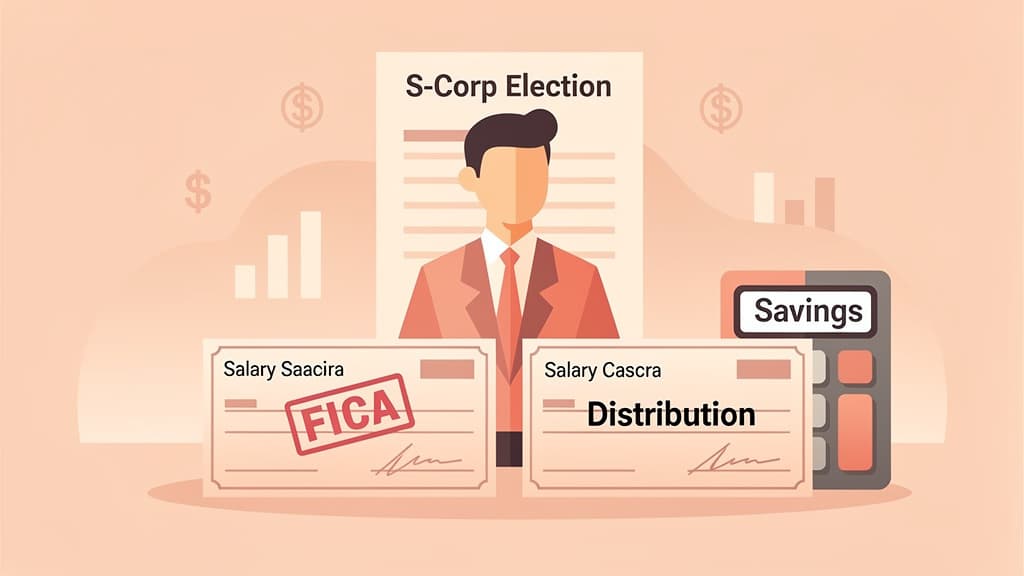
An S corporation reduces self-employment tax by splitting business profit into two streams: a reasonable W-2 salary, which pays 15.3% in FICA taxes, and shareholder distributions, which pay no FICA or self-employment tax at all. On $100,000 of net profit with a $60,000 salary, that means $9,180 in payroll taxes instead of $14,130 in self-employment tax — $4,950 less in employment taxes before roughly $2,000-$3,000 in payroll and filing costs. The IRS's one condition: the salary must be "reasonable compensation" for the work you actually perform.
Key takeaways:
- S corp distributions are not subject to self-employment tax or FICA. Only the W-2 salary is (IRC §3121)
- 2026 SE tax for a default LLC: 15.3% on 92.35% of net profit: 12.4% Social Security up to $184,500 plus 2.9% Medicare with no cap
- Reasonable compensation is a facts-and-circumstances test (IRS Fact Sheet 2008-25); a $24,000 salary on $200,000+ of profit lost in court (Watson, 2012)
- Net savings after compliance costs: roughly break-even at $75,000 profit, ~$2,000 at $100,000, ~$10,000 at $200,000
- Break-even: about $50,000-$60,000 of consistent net profit
Estimated 2026 savings by income level (single filer, federal only):
| Net Profit | Total Federal Tax Saved | Net After $2,000-$3,000 S Corp Costs |
|---|
| $75,000 | ~$2,600 | ~break-even |
| $100,000 | ~$4,400 | ~$1,400-$2,400 |
| $150,000 | ~$8,550 | ~$5,600-$6,600 |
| $200,000 | ~$12,700 | ~$9,700-$10,700 |
Deciding between structures first? Start with our S Corp vs LLC Guide 2026; this article covers the savings mechanics in depth.

When you operate as a sole proprietor or default single-member LLC, the IRS treats every dollar of net profit as self-employment income. You owe 15.3% in FICA taxes on that income: 12.4% for Social Security (on the first $184,500 in 2026) and 2.9% for Medicare (no cap).
W-2 employees pay only 7.65% because their employer covers the other half. As a self-employed person, you're both the employer and the employee, so you pay the full 15.3%.
The IRS gives a small break: you calculate SE tax on 92.35% of net earnings (not 100%), and you deduct half of the SE tax on your personal return. But the bill is still substantial:
| Net Profit (default LLC) | Taxable SE Earnings (× 92.35%) | 2026 SE Tax |
|---|
| $100,000 | $92,350 | $14,130 |
| $150,000 | $138,525 | $21,194 |
| $200,000 | $184,700 | $28,234 (12.4% capped at $184,500 + 2.9% on the full amount) |
For the full breakdown of self-employment tax mechanics, see our Self-Employment Tax Guide 2026.
Legal citation: IRC §1401 sets SE tax rates. IRC §1402(a)(12) establishes the 92.35% multiplier.
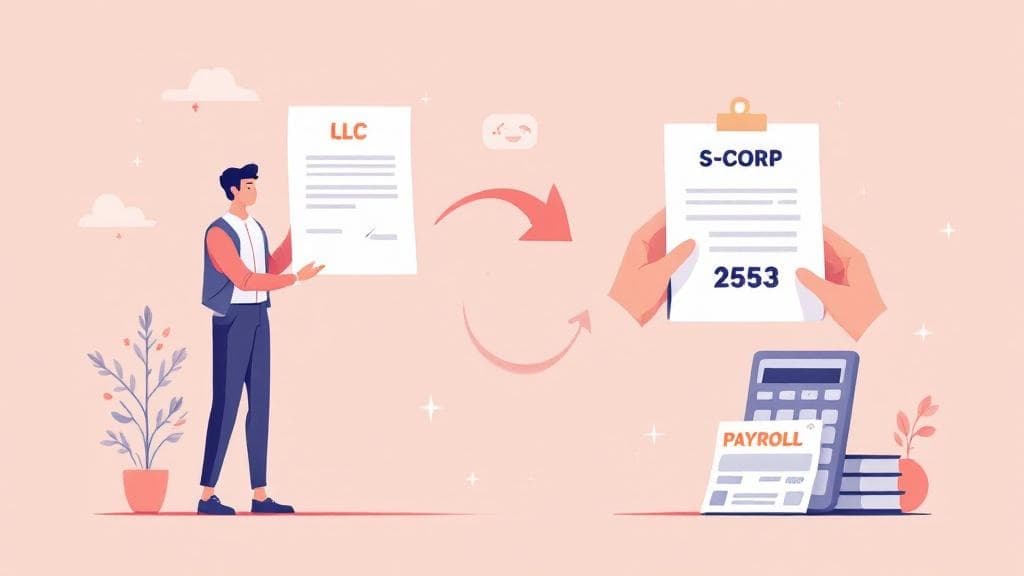
When you elect S corp tax treatment (by filing IRS Form 2553), the IRS stops treating all your profit as self-employment income. Instead, it creates a split:
-
W-2 Salary: You pay yourself a reasonable salary through payroll. This salary is subject to FICA taxes (employer share 7.65% + employee share 7.65% = 15.3%).
-
Distributions: Any remaining profit after your salary passes through to you as a shareholder distribution via Schedule K-1. These distributions are not subject to FICA taxes.
-
Income tax: Both the salary and distributions are still subject to federal and state income tax. The S corp doesn't save you any income tax — only FICA.
The tax savings come from the gap between your total net profit and your reasonable salary. Every dollar in that gap avoids 15.3% in FICA taxes.
Worked example at $120,000 net profit: With a $65,000 reasonable salary, FICA on the salary is $65,000 × 15.3% = $9,945, and the $55,000 distribution pays nothing. As a default LLC the same profit would owe $120,000 × 92.35% × 15.3% = $16,955 in SE tax. FICA savings: $7,010 per year.
The bigger the gap between your salary and total profit, the bigger the savings. But the IRS limits how wide you can make that gap: your salary must be "reasonable compensation" for the work you actually do.
Legal citation: IRC §1361-1379 governs S corporation taxation. IRC §3121(a) defines wages subject to FICA.
All four scenarios assume: single filer, 2026 standard deduction ($16,100), no other income, QBI deduction ignored (see Mistake #6), federal taxes only. Reasonable salaries follow common benchmarks. Income tax figures use the 2026 brackets from Rev. Proc. 2025-32 and are rounded.
| LLC (Default) | S Corp ($50,000 salary) |
|---|
| SE/payroll taxes | $10,597 | $7,650 ($3,825 employer + $3,825 employee) |
| Income tax deduction | $5,299 (half of SE tax) | $3,825 (employer FICA) |
| Taxable income | $53,601 | ~$55,075 |
| Federal income tax | ~$6,500 | ~$6,830 |
| Total federal tax | ~$17,100 | ~$14,480 |
FICA savings are $2,947, but the S corp's slightly smaller income-tax deduction claws back about $330. Total federal tax saved: about $2,620. After $2,000-$3,000 in compliance costs, the election is roughly break-even.
Verdict: Marginal. At $75K, the S corp barely breaks even. If your compliance costs are on the higher end, you could actually lose money.
| LLC (Default) | S Corp ($60,000 salary) |
|---|
| SE/payroll taxes | $14,130 | $9,180 ($4,590 employer + $4,590 employee) |
| Income tax deduction | $7,065 (half of SE tax) | $4,590 (employer FICA) |
| Taxable income | $76,835 | ~$79,310 |
| Federal income tax | ~$11,620 | ~$12,160 |
| Total federal tax | ~$25,750 | ~$21,340 |
FICA savings are $4,950; after the income-tax offset, total federal tax saved is about $4,410. Net after $2,000-$3,000 in costs: roughly $1,400-$2,400 per year.
Verdict: Clear win. This is about where the election starts making sense for most people.
| LLC (Default) | S Corp ($75,000 salary) |
|---|
| SE/payroll taxes | $21,194 | $11,475 ($5,738 employer + $5,738 employee) |
| Income tax deduction | $10,597 (half of SE tax) | $5,738 (employer FICA) |
| Taxable income | $123,303 | ~$128,162 |
| Federal income tax | ~$22,190 | ~$23,360 |
| Total federal tax | ~$43,390 | ~$34,835 |
FICA savings are $9,719; total federal tax saved is about $8,550. Net after costs: roughly $5,600-$6,600 per year.
Verdict: Significant. At this income level, there's almost no reason not to have the S corp election (assuming you meet eligibility requirements).
| LLC (Default) | S Corp ($90,000 salary) |
|---|
| SE/payroll taxes | $28,234 (Social Security capped at $184,500) | $13,770 ($6,885 employer + $6,885 employee) |
| Income tax deduction | $14,117 (half of SE tax) | $6,885 (employer FICA) |
| Taxable income | $169,783 | ~$177,015 |
| Federal income tax | ~$33,350 | ~$35,080 |
| Total federal tax | ~$61,580 | ~$48,850 |
FICA savings are $14,464; total federal tax saved is about $12,730. Net after costs: roughly $9,700-$10,700 per year.
Verdict: Major savings. The higher your income, the more the S corp election pays off.
Use our S Corp Salary Calculator to run the numbers for your specific income level.
The S corp tax advantage depends entirely on the split between salary and distributions. Naturally, you'd want to minimize your salary and maximize distributions to save the most in FICA taxes. The IRS anticipated this, and it's the single biggest audit trigger for S corp owners.
The IRS requires S corp shareholder-employees to receive "reasonable compensation" for the services they perform. There's no exact dollar amount or formula in the tax code. Instead, the IRS uses a facts-and-circumstances analysis.
IRS Fact Sheet 2008-25 outlines the factors considered:
- Training and experience: More specialized skills justify higher salaries
- Duties and responsibilities: What you actually do in the business
- Time and effort: How many hours you devote
- Comparable wages: What similar positions pay in your area and industry
- Dividend history: Whether you've paid distributions in prior years
- Compensation agreements: Formal employment agreements matter
- Use of a compensation formula: Consistent methodology is favorable
- Amounts paid to non-shareholder employees: Your salary should be comparable
While there's no official formula, a common guideline in the tax community is the 60/40 split: setting your salary at approximately 60% of net profit. This is a starting point, not a rule.
| Net Profit | 60/40 Starting Point |
|---|
| $100,000 | $60,000 salary / $40,000 distribution |
| $150,000 | $90,000 salary / $60,000 distribution |
| $200,000 | $120,000 salary / $80,000 distribution |
However, the 60/40 rule can produce unreasonable results at very high or very low income levels. A business netting $500,000 doesn't necessarily need to pay a $300,000 salary if comparable positions pay $150,000.
The IRS targets S corp owners who:
- Pay no salary at all: Taking only distributions is a red flag that virtually guarantees IRS scrutiny
- Pay unreasonably low salaries: A $20,000 salary for a business consultant whose business nets $200,000 won't hold up
- Have no documentation: No compensation study, no written rationale, no comparable salary research
- Dramatically change salary year to year: Paying $80,000 one year and $30,000 the next without a clear business reason
- Research comparable salaries: Use Bureau of Labor Statistics data, Glassdoor, PayScale, or industry surveys
- Document your methodology: Write down how you arrived at the salary amount and keep it in your records
- Consider a compensation study: For high-income S corps, a third-party compensation analysis provides strong audit protection
- Be consistent: Adjust salary annually based on business performance, but avoid dramatic swings
- When in doubt, go higher: Underpaying triggers more problems than overpaying
Legal citation: IRS Fact Sheet 2008-25 addresses reasonable compensation for S corp shareholder-employees. In David E. Watson, P.C. v. United States (8th Cir. 2012), a CPA's $24,000 salary against $200,000+ in annual distributions was ruled unreasonable, with back payroll taxes and penalties.
The FICA savings are real, but they don't exist in a vacuum. S corp status comes with additional costs that eat into your savings.
You must run formal W-2 payroll for yourself. This means:
- Payroll service fees: $30-$100/month for basic services like Gusto or ADP Run ($360-$1,200/year)
- Payroll tax filings: Quarterly Form 941, annual Form 940, state payroll tax returns
- Workers' compensation: Required in most states, even for single-member S corps
- W-2 and W-3 filing: Annual wage statements to you and the SSA
A default LLC files Schedule C attached to Form 1040. An S corp files a separate Form 1120-S, plus Schedule K-1 to pass income through to you. This means:
- Higher tax preparation costs: Expect $1,000-$2,500 for a CPA to prepare your 1120-S and personal return, compared to $200-$500 for a Schedule C
- Earlier deadline: Form 1120-S is due a month before Form 1040 (March 16, 2026 vs April 15, 2026)
Some states charge additional taxes or fees for S corps:
- California: 1.5% franchise tax on S corp net income (minimum $800/year)
- New York City: Unincorporated Business Tax doesn't apply, but state S corp filing fees do
- Tennessee: Franchise and excise tax may still apply
- Many states: Additional annual registration fees
| Cost Item | Annual Range |
|---|
| Payroll processing | $500-$1,200 |
| Additional tax prep | $800-$2,000 |
| State fees | $0-$800 |
| Workers' comp | $200-$600 |
| Total | $1,500-$4,600 (typically $2,000-$3,000) |
The break-even point is the income level where your FICA savings exceed your additional S corp costs. Below this point, the S corp election costs you money.
The comparison: FICA savings ≈ (net profit × 92.35% × 15.3%) minus (reasonable salary × 15.3%). S corp costs run about $2,000-$3,000 per year depending on state and provider. The election pays once the first number beats the second.
| Net Profit | S Corp Recommendation |
|---|
| Under $40,000 | Almost never worth it — costs exceed savings |
| $40,000-$60,000 | Marginal — may break even |
| $60,000-$80,000 | Usually worth it — modest net savings |
| $80,000-$150,000 | Strongly recommended — net savings of roughly $2,000-$6,500 |
| Over $150,000 | Almost always worth it — net savings typically exceed $6,000 and reach five figures near $200,000 |
Important caveat: These ranges assume you can pay yourself a reasonable salary that's meaningfully lower than your total net profit. If your business requires highly specialized skills where comparable salaries are very high, the gap between salary and distributions narrows, reducing the savings.
For state-by-state filing requirements and the LLC-side comparison, see our S Corp vs LLC Guide 2026.
One point of confusion: S corp distributions are not the same as qualified dividends. Understanding the difference is important.
- Paid by C corporations to shareholders
- Taxed at preferential long-term capital gains rates (0%, 15%, or 20%)
- Subject to the 3.8% Net Investment Income Tax (NIIT) for high earners
- Passed through via Schedule K-1
- Not subject to FICA/SE tax — that's the savings
- Taxed as ordinary income at your marginal rate (10%-37%)
- Not subject to NIIT when you materially participate in the business (passive S corp income can be subject to NIIT)
The S corp advantage is FICA avoidance, not a lower income tax rate. Distributions are still taxed as ordinary income; they just skip the 15.3% employment tax.
Legal citation: IRC §1(h)(11) governs qualified dividend rates. IRC §1366 governs the pass-through of S corp income.
The problem: Paying yourself $30,000 when your business nets $180,000 and comparable positions pay $80,000-$100,000.
The consequence: The IRS reclassifies distributions as wages and assesses back FICA taxes, plus penalties and interest. The Watson case resulted in exactly this outcome.
The fix: Research comparable salaries, document your methodology, and err on the side of paying yourself more rather than less.
The problem: Taking all business income as distributions and paying no W-2 salary at all.
The consequence: This is the most obvious red flag for IRS examiners. The IRS will reclassify a significant portion of distributions as wages.
The fix: Always pay yourself at least some W-2 salary. Even if you're debating the exact amount, paying something is far better than paying nothing.
The problem: Filing Form 2553 when net profit is $30,000 because someone told you "S corps save on taxes."
The consequence: You spend $2,000-$3,000 on payroll and tax prep but save only $1,000-$1,500 in FICA. Net loss.
The fix: Wait until your net profit consistently exceeds $50,000-$60,000 before electing S corp status. Use our Self-Employment Tax Calculator to model both scenarios at your current income.
The problem: Calculating federal FICA savings without accounting for California's 1.5% S corp franchise tax or other state costs.
The consequence: Your "savings" evaporate when state fees are factored in.
The fix: Check your state's S corp requirements and fees before making the election. States like California, New York, and Illinois have additional costs.
The problem: Running payroll irregularly — lump-sum payments, skipping months, or paying yourself different amounts each pay period without documentation.
The consequence: IRS scrutiny and potential reclassification of distributions as wages.
The fix: Run payroll on a regular schedule (monthly or semi-monthly). Keep amounts consistent and document any changes.
The problem: Not considering how the salary/distribution split affects your Qualified Business Income (QBI) deduction.
The consequence: The QBI deduction (20% of qualified business income) applies to S corp pass-through income, and W-2 wages paid to yourself reduce the QBI base. Above the 2026 threshold ($201,750 for single filers, Rev. Proc. 2025-32), the W-2 wage limitation means you need sufficient wages to maximize QBI — creating a tension between QBI optimization and FICA minimization.
The fix: Model both the FICA savings and QBI deduction impact together. For more on QBI, see our QBI Deduction Guide 2026.
Running an S corp means knowing your net profit and your salary-to-distribution split all year, not just at filing time. Jupid is an AI accountant in WhatsApp and iMessage: connect your business bank account and it categorizes salary payments, distributions, and expenses automatically with 95.9% accuracy. Ask "What's my salary-to-distribution ratio this year?" in chat and get the current split against your running profit, so the number you show the IRS is one you tracked all year rather than reconstructed in March.
Try Jupid
For the step-by-step conversion process, see our Convert LLC to S Corp Guide 2026.
- IRC §1361: Definition and eligibility requirements for S corporations
- IRC §1362: Election procedures for S corp status
- IRC §1366: Pass-through of income, deductions, and credits
- IRC §1368: Distributions from S corporations
- IRC §1379: Shareholder-employee compensation
- IRC §3121: Definition of wages subject to FICA
- IRC §199A: Qualified Business Income deduction (and W-2 wage limitation)
| Item | 2026 Amount |
|---|
| SE tax rate | 15.3% |
| Social Security rate | 12.4% |
| Medicare rate | 2.9% |
| Social Security wage base | $184,500 |
| Additional Medicare Tax | 0.9% over $200,000 (single) |
| Standard deduction (single) | $16,100 |
| QBI deduction | 20% (permanent under OBBBA); single-filer threshold $201,750 |
| Form 2553 deadline (calendar-year 2026) | March 16, 2026 |
| Form 1120-S deadline | March 16, 2026 |
Disclaimer
This article provides general information about S corporation tax treatment and self-employment tax savings. It should not be considered tax or legal advice. S corp election decisions depend on your specific income, state of residence, business structure, and individual circumstances. The "reasonable compensation" requirement is a facts-and-circumstances determination — no single formula works for every business. Consult with a qualified tax professional or CPA before making an S corp election.
Tax Year: 2026
Last Updated: July 7, 2026