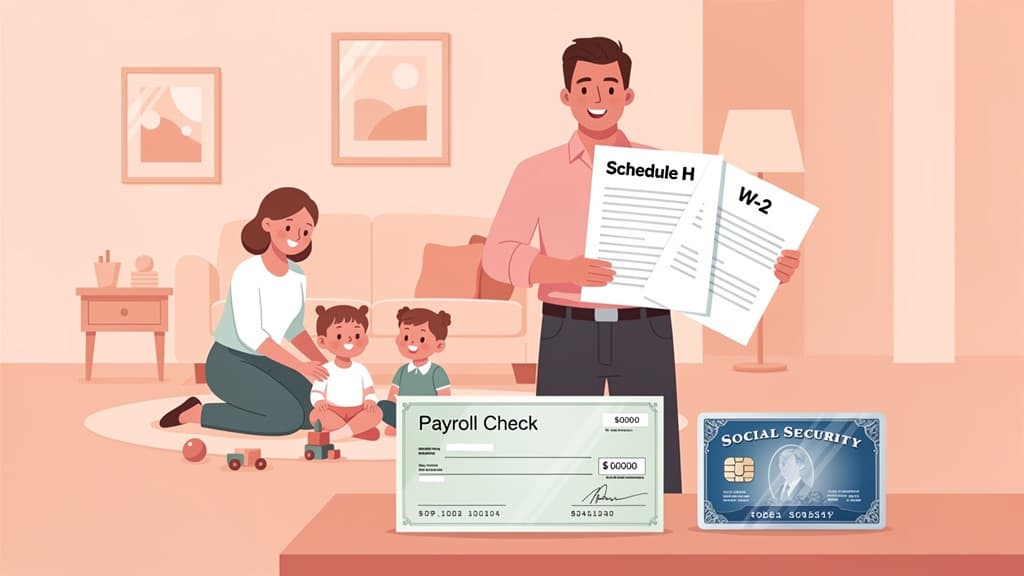
The 2026 household employee threshold is $3,000: pay any one household employee $3,000 or more in cash wages during 2026 and you owe Social Security and Medicare (FICA) taxes on all of those wages, per IRS Publication 926. That is up from $2,800 in 2025. A separate test triggers federal unemployment tax (FUTA): $1,000 or more in total household wages in any calendar quarter of 2025 or 2026.
The nanny tax is the informal name for these employment taxes, and it applies to parents employing a nanny as well as anyone who hires a housekeeper, in-home caregiver, or other domestic worker they control. You report and pay it on Schedule H, filed with your Form 1040.
Key takeaways:
$3,000 in 2026 cash wages to any one household employee triggers Social Security and Medicare taxes (the 2025 threshold was $2,800)
15.3% total FICA: 6.2% Social Security + 1.45% Medicare, split evenly; you and your employee each pay 7.65%
The Social Security wage base is $184,500 for 2026; Medicare has no cap
$1,000+ in any quarter to all household employees combined triggers FUTA: usually 0.6% on the first $7,000 per employee, about $42/year
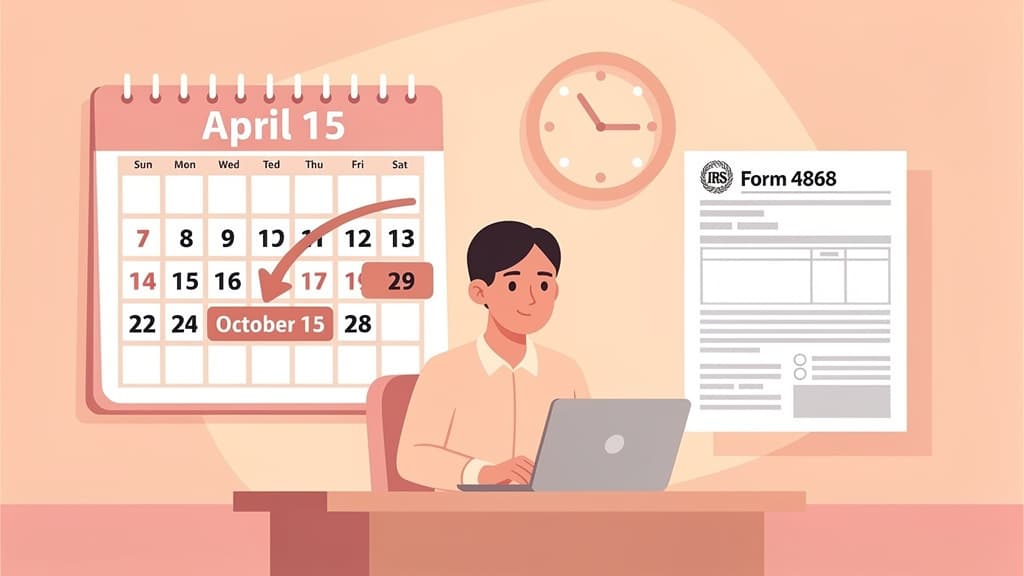
W-2 due February 1, 2027 (January 31 falls on a Sunday); Schedule H files with your 1040 by April 15, 2027
2026 Nanny Tax Overview:
Factor
Details
Social Security/Medicare threshold
$3,000 in cash wages to any one household employee
Social Security tax rate
6.2% employer + 6.2% employee (12.4% total)
Medicare tax rate
1.45% employer + 1.45% employee (2.9% total)
Social Security wage base
$184,500
FUTA threshold
$1,000 in total household wages in any quarter
FUTA tax rate
6.0% on first $7,000 (effectively 0.6% after state credit)
Filing requirement
Schedule H (Form 1040)
W-2 due to employee and SSA
February 1, 2027 (January 31 is a Sunday)
Key form
Schedule H — Household Employment Taxes
Key point: Federal income tax withholding from a household employee's wages is optional (unless the employee requests it). But Social Security and Medicare withholding is mandatory once the $3,000 threshold is met.
A household employee is someone who performs services in or around your home and whose work you control — meaning you determine not only what work is done, but how it's done.
Not everyone who works in your home is a household employee:
Independent contractors: If a worker controls how the work is done — bringing their own equipment, setting their own schedule, serving multiple clients — they may be an independent contractor, not an employee. You generally don't issue them a 1099-NEC either: that form applies to payments made in the course of a trade or business ($2,000 or more in 2026), not personal household payments. The contractor reports the income on their own return.
Workers from an agency: If you hire through an agency and the agency controls the worker (sets their schedule, provides training, handles pay), the agency is the employer — not you.
Your spouse: Wages paid to your spouse for household work are not subject to Social Security, Medicare, or FUTA taxes.
Your child under 21: Wages paid to your child under 21 for household work are not subject to Social Security, Medicare, or FUTA taxes.
Your parent (with exceptions): Wages paid to your parent are generally exempt from FUTA, and exempt from Social Security and Medicare unless you have a child under 18 living in your home (or a child of any age with a condition requiring adult care) and you are divorced, widowed, or have a spouse with a condition preventing care.
A worker under 18: Wages paid to a babysitter or other household worker who is under age 18 at any time during the year are exempt from Social Security and Medicare taxes, unless household work is their principal occupation. A student's principal occupation is being a student, so wages paid to a high-school or college babysitter typically stay exempt.
Only if the cleaner is your household employee and you pay them $3,000 or more in cash wages in 2026. A housekeeper who works on your schedule, uses your supplies, and follows your instructions is a household employee. A self-employed cleaner or cleaning company that sets its own hours, brings its own equipment, and serves many clients is an independent contractor, and you owe no employment taxes on what you pay them.
It depends on where and how the work happens. A sitter who cares for your children in your home, on your schedule, under your direction is your household employee, and the $3,000 threshold applies. A sitter who watches children in their own home (or runs a daycare serving several families) is self-employed and reports the income on Schedule C.
The IRS uses a "right to control" test. If you can direct:
What work the person does
When they do it
How they do it
What tools or supplies they use
...then you have an employer-employee relationship, regardless of what you call the arrangement or whether you have a written agreement.
Example: You hire Maria to care for your children every weekday from 8 AM to 5 PM. You tell her what meals to prepare, when nap time is, and which activities are allowed. Maria is a household employee.
Counter-example: You hire Tom's Lawn Care to maintain your yard. Tom decides when to come, brings his own mower, and serves 30 other clients. Tom is an independent contractor.
For 2026, the nanny tax obligations begin when you pay $3,000 or more in cash wages to any single household employee during the calendar year. This threshold is up from $2,800 in 2025.
The threshold is measured per employee, per calendar year. If you pay one nanny $2,500 and another $2,000, neither triggers the obligation individually. But if you pay one nanny $3,000 or more, you must withhold and pay employment taxes on all wages paid to that employee during the year — not just the amount above $3,000.
Example — threshold tracking: You pay your nanny $250/week starting in January. By week 12 (mid-March), $250 × 12 = $3,000 and the threshold is met. You now owe Social Security and Medicare taxes on all $3,000 already paid, plus every dollar you pay for the rest of the year.
The Social Security tax applies only on wages up to $184,500 per employee in 2026 (the Social Security wage base, up from $176,100 in 2025). Medicare has no wage cap. If you pay a household employee more than $200,000 in a year, you must also withhold the 0.9% Additional Medicare Tax on wages above that threshold; it is employee-only, with no employer match.
Option A — Withhold from the employee's wages. Deduct 7.65% from each paycheck and hold it until you file Schedule H. You are responsible for the matching 7.65% employer share.
Option B — Pay the employee's share yourself. You can choose to pay the full 15.3% out of your own pocket. If you do, the employee's share (7.65%) that you pay is not counted as additional taxable wages for income tax purposes, but is counted as wages for Social Security and Medicare tax purposes.
Most household employers choose Option A (withholding) because it's simpler and less expensive.
Yes. Nearly every state requires household employers to pay state unemployment insurance (SUI) if they meet the state's threshold. State thresholds vary — some are as low as $1,000 in annual wages, while others match the federal quarterly threshold.
Check your state's labor department website for the specific threshold and registration requirements.
Many household employees prefer voluntary withholding because it helps them avoid a large tax bill at filing time. Without withholding, household employees must make quarterly estimated tax payments on their own — and many forget or don't realize they need to.
If your employee asks you to withhold, it's straightforward: use the IRS tax withholding tables (Publication 15-T) to calculate the correct amount based on the employee's W-4.
Before you can file Schedule H or issue a W-2, you need an Employer Identification Number (EIN) — even if you already have one for a business. There is no separate "household employer ID number": household employers use a standard EIN.
Online: Apply at irs.gov/ein — you'll receive your EIN immediately
By mail or fax: Use Form SS-4 — processing takes 4-6 weeks (mail) or 4 business days (fax)
Cost: Free
You can use the same EIN for household employment and any business you operate, but most tax professionals recommend getting a separate EIN for household employment to keep the filings distinct.
Unlike commercial employers who deposit employment taxes throughout the year, household employers generally pay all employment taxes when they file their annual income tax return. However, you can avoid a large year-end bill by:
Increasing your own W-2 withholding (if you have a day job) — ask your employer to withhold extra from your paycheck using Form W-4
Making estimated tax payments — include the household employment taxes in your quarterly estimated payments. For 2026 liabilities the due dates are April 15, June 15, and September 15, 2026, and January 15, 2027
Important: If your household employment taxes are large enough, failing to account for them in withholding or estimated payments can trigger the estimated tax penalty.
For one household employee, most families handle nanny payroll themselves: track cash wages, withhold 7.65% FICA from each paycheck, set aside your matching 7.65%, and settle up on Schedule H at tax time. A nanny payroll service makes sense when you also owe state unemployment insurance, state withholding, or workers' comp filings. The state-side paperwork, not the federal math, is usually what pushes families to outsource.
Yes, you have to give your nanny a W-2: every household employee paid $3,000 or more in cash wages during 2026 (or who had any federal income tax withheld) must receive Form W-2 from you. A 1099 is not a substitute: household employees get W-2s.
You can file W-2s electronically through the SSA's Business Services Online (BSO) portal, or by mail using Form W-3 (Transmittal of Wage and Tax Statements) along with Copy A of each W-2.
For late W-2 filing penalties and other 1099/W-2 deadlines, see our filing deadlines guide.
If you pay a nanny to care for your children under 13 so you can work or look for work, you may qualify for the Child and Dependent Care Credit. For 2026, this credit covers up to $3,000 in care expenses for one child or $6,000 for two or more children, with a credit percentage of up to 50%. The One Big Beautiful Bill Act raised the top rate from 35% starting in 2026. The percentage starts at 50% for the lowest incomes, steps down to 35%, holds there until AGI passes $75,000 ($150,000 for joint filers), then phases down to a 20% floor.
However: You can only claim this credit if you properly report the caregiver as an employee (or independent contractor) and include their taxpayer identification number on Form 2441. Paying a caregiver "under the table" disqualifies you from the credit.
If your employer offers a Dependent Care Flexible Spending Account (DCFSA), you can contribute up to $7,500 per year pre-tax in 2026 ($3,750 if married filing separately) to cover eligible childcare expenses. The One Big Beautiful Bill Act raised the limit from the $5,000 cap that had stood since 1986. This includes wages paid to a household employee who provides dependent care. But again, you must report the employment relationship properly.
If you work from home and employ a nanny, the deduction math can overlap. The nanny enables you to work, and the home office deduction covers the space where you work. Both are legitimate — just make sure you're tracking and reporting each correctly.
High-profile nanny tax cases have derailed political careers and judicial nominations. In 1993, two of President Clinton's Attorney General nominees withdrew after revelations that they hadn't paid nanny taxes. The issue has surfaced in confirmation hearings repeatedly since then.
The lesson: the IRS — and the public — views household employment tax compliance as a basic obligation. Non-compliance carries reputational risk beyond the financial penalties.
Mistake #1: Treating a household employee as an independent contractor. The most common error. If you control when and how the work is done, the worker is your employee, regardless of what your verbal agreement says. Misclassifying an employee as a contractor doesn't eliminate your tax obligations; it just adds penalties when the IRS catches it. At Anna Money, we handled payroll compliance for 60,000+ UK small businesses, and this exact blind spot came up constantly: owners running fully compliant business payrolls who never realized the same obligations extended to the person watching their kids. See our full guide on employee vs. contractor classification.
Mistake #2: Ignoring the $3,000 threshold because it "seems small." $3,000 over a full year is about $58 per week. If you have a regular babysitter, housekeeper, or part-time caregiver, you can hit this threshold quickly. Track payments throughout the year.
Mistake #3: Not getting an EIN. You cannot file Schedule H without an EIN. Apply early in the year — don't wait until January when you need to issue W-2s.
Mistake #4: Paying "under the table" to avoid the hassle. Paying cash without withholding and reporting doesn't save you money — it creates liability. You lose the Child and Dependent Care Credit, you face penalties if caught, and your employee loses Social Security credits and unemployment insurance eligibility.
Mistake #5: Forgetting about state requirements. Federal compliance is only half the story. Many states have lower thresholds than the federal $3,000, and some require workers' compensation insurance for household employees. Check your state's rules separately.
Managing nanny tax obligations adds a layer of complexity to your personal finances — especially if you're already running a business. Jupid helps you keep everything organized so nothing falls through the cracks.
Automatic transaction categorization. Jupid connects to your bank accounts and categorizes transactions with 95.9% accuracy. Payments to household employees are tracked alongside your other financial activity, giving you a clear picture of what you've paid and when.
Threshold tracking. When payments to a household worker approach the $3,000 threshold, you'll know it — because Jupid has been categorizing those transactions all along. No more scrambling to add up a year's worth of Venmo payments in January.
AI-powered answers via WhatsApp and iMessage. "Do I need to pay nanny taxes?" "What's the FUTA threshold?" "When is Schedule H due?" Ask Jupid's AI accountant and get specific answers about your household employment obligations, right from your phone.
Organized records for tax time. When it's time to file Schedule H and issue W-2s, your payment records are already organized and categorized. No guessing, no reconstructing, no missed payments.
Whether you're a solopreneur with a part-time nanny or a small business owner with multiple household employees, Jupid keeps your finances clear and your compliance on track. Get started at Jupid.
The nanny tax catches many people by surprise, but the rules are straightforward once you understand them. Pay $3,000 or more to a household employee in 2026, and you owe Social Security and Medicare taxes. Pay $1,000 or more in any quarter, and you owe FUTA. File Schedule H with your 1040, issue a W-2 by February 1, 2027, and keep records for four years. Following these steps protects both you and your employee.
Last updated: July 11, 2026
Disclaimer:This article is for informational purposes only and does not constitute legal, tax, or financial advice. Tax laws and thresholds change annually. State requirements vary significantly. Consult a qualified tax professional for advice specific to your situation. Jupid provides automated bookkeeping and tax categorization — we are not a CPA firm or tax advisory service.
Fintech CEO with 10+ years building accounting and financial technology products. Previously co-founded and scaled an AI-powered accounting platform to $30M revenue and 100K+ business users, achieving 30,000 customers per accountant through automation — recognized by CNBC as a top fintech company. Holds a Master's in Management Information Systems. At Jupid, he leads the development of AI-native bookkeeping, tax, and compliance tools designed for freelancers and small business owners.